Automate HVAC inspections


Reduced Liability, Higher Safety, Lower Operational Risk
How consistent inspections and documented evidence reduce incidents, liability, and downtime in large facilities.
Want to discuss how this applies to your facility?
Why incidents are expensive
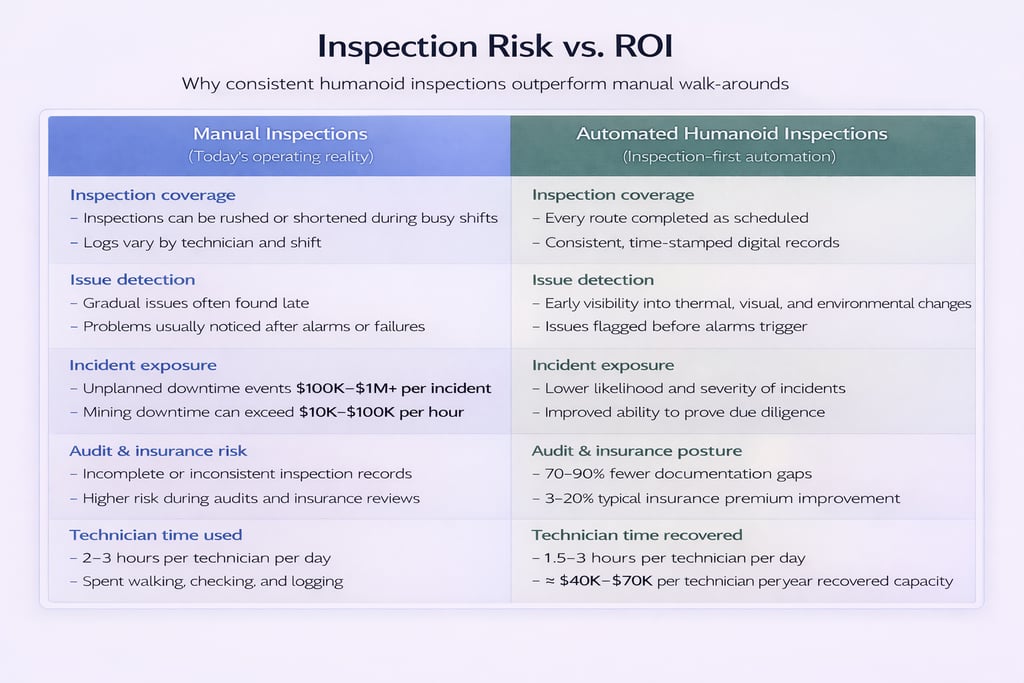
In large data centers and Bitcoin mining facilities, most high-impact incidents do not start as sudden failures. They develop slowly due to conditions such as airflow degradation, dust buildup, condensation, overheating components, or blocked vents.
Industry studies and operator disclosures show that unplanned facility downtime typically costs between $100,000 and $1,000,000+ per incident, depending on facility size, redundancy tier, and duration. In mining facilities, downtime can directly translate into $10,000–$100,000+ per hour in lost revenue.
In post-incident reviews, a common finding is not lack of monitoring systems, but missed inspections, delayed detection, or incomplete inspection records across multiple shifts.
Why inspections matter for liability and insurance
Auditors, insurers, and safety authorities expect proof of physical inspections, not just sensor data.
Across audited environments:
Incomplete or inconsistent inspection logs are one of the most common audit findings
Insurance claims are frequently delayed or reduced due to lack of inspection evidence
Facilities struggle to prove due diligence when inspections rely on manual notes and photos
In practice, documentation quality matters as much as maintenance quality when incidents occur.
How humanoid inspections reduce risk
Humanoid inspections reduce operational risk by ensuring inspections are actually completed every shift, without shortcuts.
They create a continuous, time-stamped inspection record showing:
Exact inspection time and route
Visual and thermal condition of equipment
Before/after evidence where applicable
This improves:
Inspection consistency across 3 shifts per day
Visibility into slow-developing issues that often go unnoticed for days or weeks
Defensibility during audits, insurance reviews, and incident investigations
Facilities typically reduce inspection-related gaps by 70–90%, based on consistency alone.
Why this matters to leadership
Leadership ROI is not based on preventing every incident. It is based on reducing probability and severity.
Even a 5–10% reduction in the likelihood or impact of a major incident can justify several years of inspection automation cost. This is why facilities continue to require physical walk-around inspections even when BMS and sensors are in place.
Humanoid inspections compress risk by:
Reducing missed inspections
Improving early detection
Strengthening evidence of due diligence
Designed for audited, regulated environments
The system is intentionally limited to inspection and documentation.
It does not:
Perform repairs
Change controls
Handle electrical or refrigerant work
Make autonomous operational decisions
All judgment and corrective actions remain with licensed technicians, ensuring compliance with safety, insurance, and regulatory frameworks.
Want the full analysis?
For teams that want a deeper breakdown of inspection economics, incident risk, labor impact, and phased deployment value, we provide a detailed written analysis.
Want to understand how this applies to your facility?

Get in Touch
Questions about reducing liability or boosting safety? Reach out anytime.
Phone
555-0198
contact@safetyfindings.com